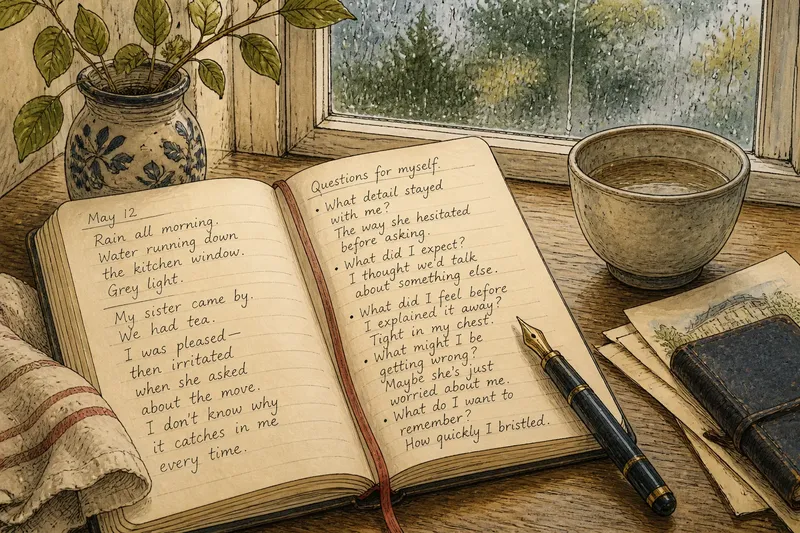
Five Questions for a Change of Season
Five questions for a change of season help you decide which commitments still fit, which need renegotiating and what deserves your attention next.

You open your calendar to arrange a dentist appointment and find three Saturday commitments already pencilled in. Five questions for a change of season can help you decide which promises still fit, and which have simply stayed put because nobody moved them.
This is less about reviewing your habits than about checking the terms of your choices. A commitment can reflect a value and still need a different shape. You can care about a friend without being available every Thursday; you can value creative work without making it another obligation.
Separate values from arrangements
Write down a commitment that has begun to feel awkward. Then name the value you hoped it would express: care, contribution, curiosity, reliability, or something else. Keep the distinction clear. The value may still matter even if the arrangement no longer works.
For instance, helping with a community group might express solidarity, while attending every planning meeting is only one way of helping. The useful question is not simply whether to quit. Ask what the commitment is for, and whether its current form still serves that purpose.
Name the value before deciding what to change.
Five questions for a change of season
What promise still feels like mine?
Look for a commitment you would choose again, rather than one you maintain chiefly because it is familiar. Notice what makes it feel worthwhile: the person involved, the activity itself, or the way it fits alongside other parts of your life. That detail can help you preserve what matters if circumstances shift.
Which boundary needs saying aloud?
A limit that exists only in your head is difficult for other people to respect. Identify the specific request or time slot that has become too much, then decide what you can actually offer instead. A clear boundary might be “I can help on Tuesday, but not at the weekend,” rather than a vague promise to be less busy.
What have I agreed to by default?
Check recurring tasks, group roles and informal expectations. Ask whether you actively chose them, whether anyone else could share them, and what you would need to say to change the arrangement. A default can be useful; it is not automatically a lifelong appointment.
What do I want to express more clearly?
Consider a preference, opinion or need you have been softening until it is hard to recognise. You need not turn it into a declaration. A direct, ordinary sentence can be enough: “I would rather meet somewhere quiet,” or “I cannot take that on this week.”
What decision can wait?
Some choices need more information, while others need time for an initial reaction to settle. Separate an actual deadline from the discomfort of leaving something unresolved. If there is no immediate consequence to waiting, decide when you will look at the question again rather than repeatedly reopening it.
Check the trade-offs
Before changing a commitment, write down three things: what you want to protect, what the current arrangement costs you, and what another person may need to know. This keeps a decision grounded in practical consequences rather than in a vague wish to become a different sort of person.
Use this quick check for each possible change:
- Time: If the commitment regularly takes time you need for rest or other responsibilities, then ask to reduce or reschedule it; otherwise, keep the timing and check the other trade-offs.
- Energy: If you feel drained before the activity begins, then consider changing its frequency or format; if the strain comes from a separate task, address that task instead.
- Value: If you can still name a value the commitment serves, then look for a workable way to preserve that value; if you cannot, ask whether habit alone is keeping it in place.
- Choice: If you would not agree to the same arrangement now, then raise a change with the people involved; if you would choose it again, keep it and clarify any conditions you need.
- Alternatives: If another person could share the work, then ask about dividing it; if the task cannot be shared, decide whether to continue it, reduce its scope or step away.
- Timing: If a real deadline is close, then choose the smallest workable action before it; if there is no deadline, set a specific time to revisit the decision and leave it alone until then.
These checks do not make a choice for you. They make the relevant choice easier to see.
How do I decide?
How do I say no without overexplaining?
State the limit plainly, then offer an alternative only if you genuinely want to. “I cannot host this month, but I can bring food” is clearer than a long account of every competing demand. You do not need to persuade someone that your boundary is legitimate.
What if someone is disappointed?
Disappointment may be part of a change, particularly if another person relied on the old arrangement. Hear what they need and be honest about what you can provide, without agreeing to something you have already decided is unsustainable. A kind conversation can still contain a firm answer.
When should I postpone a choice?
Postpone it when waiting could bring useful information and no important deadline is being ignored. Name what you are waiting to learn and when you will check again. If nothing can change the answer, more delay may only prolong the discomfort.
A worked decision
Say you have agreed to bring refreshments to a neighbourhood meeting each month. You value being part of the group, but shopping and preparation have begun to crowd out your Sunday evening. You check the next meeting date, note that another member has offered to help, and decide you can bring fruit but cannot prepare several dishes.
You message the organiser with that limit and ask whether the other member can share the task. The organiser agrees to divide it. The observable result is a smaller contribution and less preparation; if nobody can share the work, your alternative is to bring one simple item or step back from refreshments. Either way, the decision protects participation without pretending the old arrangement was effortless.
Keep the decision open
A choice need not settle every future version of your life. Try the revised arrangement for a while, then notice whether it respects the value you meant to keep and the boundary you meant to set. If either has been lost, adjust again.
Return to five questions for a change of season when an existing promise no longer feels like a choice. The aim is not to clear your calendar or produce a more impressive self. It is to make the next conversation or decision more honest than the default it replaces.