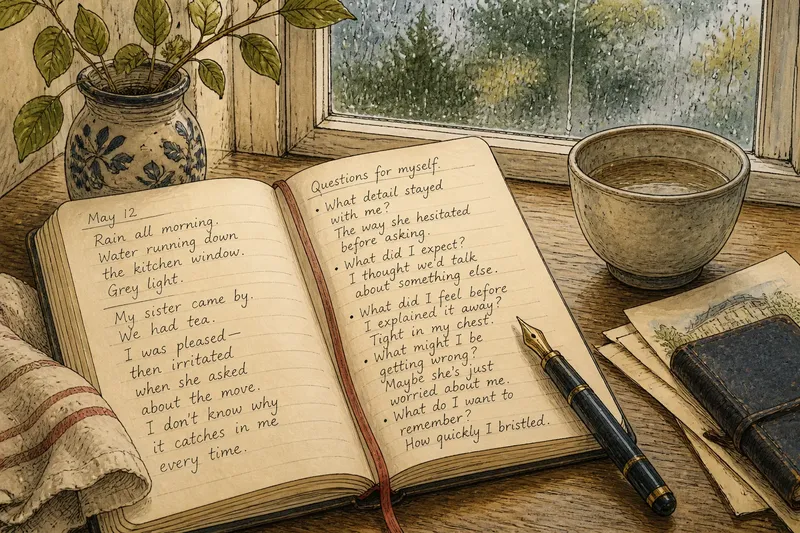
The Fresh-Start Trap After a Missed Day
The fresh-start trap makes one missed day feel like failure. Learn to choose a workable next occasion and keep a habit aligned with your actual intention.
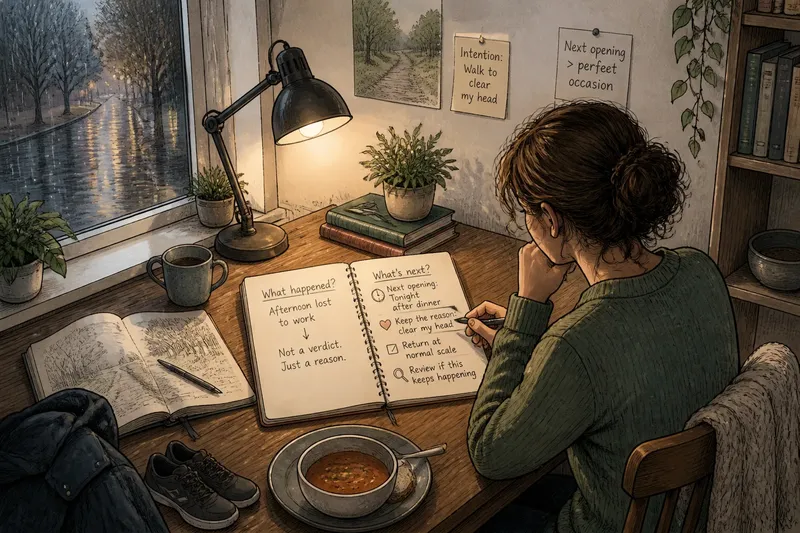
You planned a short walk after lunch, but a meeting ran late and rain began tapping at the windows. By evening, the missed walk had become a verdict on your whole routine. The fresh-start trap turns an ordinary interruption into a reason to begin again on Monday. A better response is to decide what the next suitable occasion actually is.
Name the interruption
A missed occasion has a cause. It may be a crowded schedule, low energy, a change in your surroundings or a loss of interest. Naming the cause keeps the event specific. “I didn’t walk because the afternoon disappeared into work” gives you something to respond to; “I never stick to anything” turns a scheduling problem into a character assessment.
This is not a reason to excuse every choice. It is a way to distinguish an obstacle from a decision. Choosing rest because you need it differs from forgetting the habit existed. Finding that the habit no longer suits you is different again. Each calls for its own next move.
Write down the practical reason, without adding a prosecution brief.
Find the next opening
A habit need not wait for Monday, a clear calendar or a promising mood. It can continue at the next suitable opening: perhaps the next evening, meal or time you are already near the place where it happens.
“Next opportunity” should mean a real occasion, not a vague promise to do better soon. If you read before bed, the next opening might be tonight when you put your phone on charge. If you stretch after work, it might be when you change out of your work clothes. A clear cue makes the moment easier to recognise.
Choose the next ordinary opening, not a ceremonial new beginning.
Keep the intention
A habit often carries a reason beneath the action. You might walk to clear your head, cook at home to make evenings calmer or practise a language to speak with a relative. Missing an occasion does not automatically cancel that reason. You can keep the intention while deciding whether the action or timing needs to change.
Say you planned to write a few lines each morning, but a family obligation takes up the morning. In this invented situation, the morning is no longer available. You move the writing to that evening and leave the notebook beside your chair. The observable result is a clear next occasion, though the routine no longer happens at the same time each day.
Keep the reason; adjust the occasion if needed.
Resist repayment
After missing a day, it can be tempting to compensate by doing twice as much, extending the routine or adding a stricter rule. That turns an interruption into a debt. The extra burden can make the next occasion feel less inviting, especially when the habit was meant to fit ordinary life.
Returning to the usual version is clearer than inventing a penalty. If you missed a reading session, the next one can simply be the usual session. If that version no longer fits, choose a smaller one deliberately. A sensible adjustment is not the same thing as punishment dressed as discipline.
Resume at the scale you actually want to keep.
Review repeated friction
One missed occasion is an event. Repeated interruptions may show that the arrangement does not fit. Perhaps the chosen time conflicts with school drop-off, the materials are in another room or the habit depends on a quiet evening that rarely arrives. Ask what the repeated friction says about the plan, rather than whether you are committed enough.
Change one relevant feature at a time. Move the cue, prepare the materials earlier or choose a different version of the action. If the habit has become irrelevant, you may decide to stop it. Continuing by default is no more thoughtful than abandoning it after one missed occasion.
Let repeated friction prompt a review, not a scolding.
Keep a plain record
A record can help you see what is happening, provided it describes rather than judges. A calendar mark, a short note or a tick beside the next planned occasion may be enough. A blank square is not a character reference, though calendars can look remarkably certain of themselves.
If you note an interruption, include what you chose next. “Skipped the walk; took the next available route home on Wednesday” says more about the habit’s fit than an unbroken streak. The record can help you decide whether to continue as planned, adapt the cue or reconsider the habit.
Record the next choice, not a score.
Questions about missed days?
Should I wait until Monday?
Only if Monday is genuinely the next suitable occasion. Otherwise, waiting can make a small interruption feel like a formal cancellation.
Does a smaller version count?
It can, if it serves the intention you chose. Decide what the smaller version is for instead of using it to punish yourself for missing the original.
What if I keep missing the same occasion?
Treat the repetition as information about the cue, timing or fit of the habit. Adjust the arrangement, or decide plainly that the habit no longer belongs in your routine.
A fresh start can feel satisfying because it makes the calendar look clean. But a missed occasion does not require a new identity or a new timetable. Notice what happened, then make the next decision on its own terms: resume, adapt the cue or let the habit go.